
Why Time Management Won't Fix Your Burnout
May 26, 2026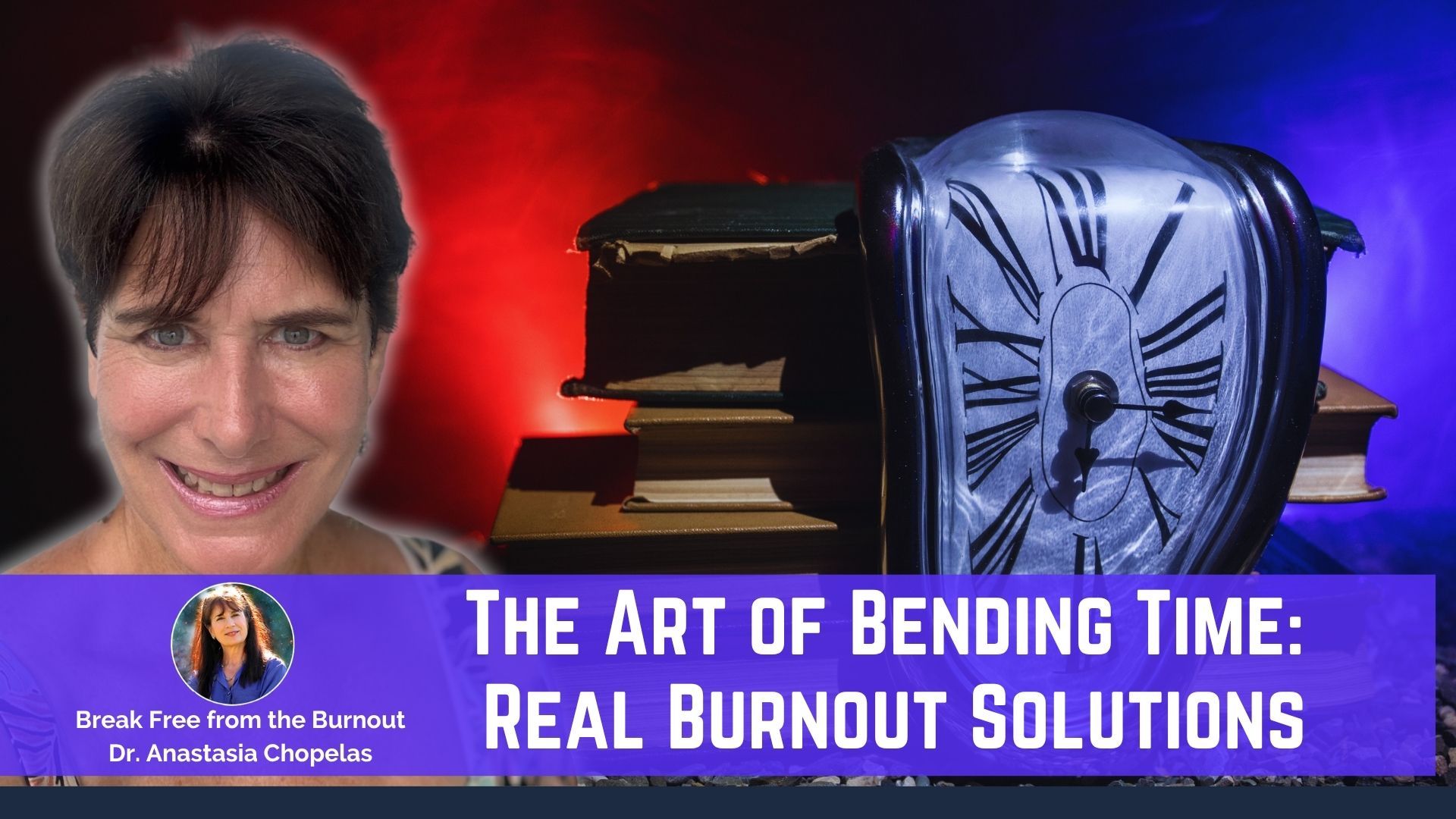
Burnout disguises itself as a time management problem — but no planner, app, or productivity course can fix a depleted energy field. In this episode of Break Free from the Burnout, former attorney and coach Michelle Nemeyer shares her Art of Bending Time framework, which starts with clarity and alignment, clears the internal and external drains on your attention, and helps you accomplish more in the same hours without running yourself into the ground. If you've been working harder with less to show for it, the problem almost certainly isn't your calendar.
You bought the time management course. You color-coded the calendar. You set the earlier alarm. And somehow you're still behind, still exhausted, and still wondering why the same amount of work that used to feel manageable now feels like pushing through wet concrete.
Here's what nobody tells you: when you're burning out, poor time management isn't the problem. It's the symptom.
Michelle Nemeyer spent 20 years as an attorney before an autoimmune diagnosis stopped her in her tracks. What she found on the other side — after holistic healing, clarity work, and a complete rethink of how she structured her hours — became her Art of Bending Time framework. In this conversation on Break Free from the Burnout, she explains why high-achieving professionals keep reaching for the wrong tool, and what actually works for professional burnout recovery.
Burnout Doesn't Announce Itself — It Creeps In
Burnout builds slowly. Michelle describes it the same way I talk about energy depletion with my clients: it doesn't arrive all at once.
"It's like being a lobster in a pot," she says. "The water's getting warmer, things feel different, and you become very detached."
Most people who are burning out don't feel burned out. They feel off. Slightly less sharp. A little more resentful. Re-reading the same paragraph before it finally registers. That's the early warning system going off — and most high achievers ignore it completely because nothing is technically wrong yet.
Michelle's own signs showed up as spinning wheels at work. She'd successfully practiced law for 20 years without needing a time management course. Then suddenly she couldn't get through basic tasks. Her first instinct? Buy a time management course.
That's what makes burnout so sneaky. It mimics a skills problem when it's actually an energy problem. You're not suddenly bad at your job. Your system — physical, mental, emotional — is running low, and focus is one of the first things to go when that happens.
What makes it harder to catch is that many driven professionals use work as a stabilizing force. Michelle was candid about this: her demanding workload was partly how she held herself together during a difficult marriage. When that marriage ended, the burnout that had been quietly accumulating for years hit all at once. Her body finally said, okay, we can stop holding it together now — and it let go of everything at the same time.
The small signs deserve your attention long before a diagnosis or a crisis forces it.
Why Another Time Management Course Won't Save You
Here's what I find super duper important about what Michelle shared: the people who most need burnout support aren't looking for burnout support. They're looking for a productivity fix.
When she felt herself falling behind, she didn't think I'm burning out. She thought I must not be organized enough. So she bought a time management course. The problem wasn't time — it was that her energy was depleted to the point where focus had become physiologically difficult.
This is exactly what I see in the energy healing work I do. People come in exhausted, foggy, spinning. They've tried every strategy. They've read the books. They've built the habits. And nothing sticks — not because the strategies are bad, but because you cannot out-organize a depleted energy field. That's not a time problem. That's a body problem, a nervous system problem, an energetic depletion problem.
Michelle puts it plainly: "When you're burned out, you're not focused. When you lack focus, you can't do what you need to do." No calendar fixes that.
She identifies two categories of what she calls "time sucks" — and both are worth paying close attention to. Internal time sucks are the self-soothing habits that kick in when you're avoiding a difficult task. Scrolling. Checking email repeatedly. Playing a mindless game. These aren't laziness. They're avoidance responses from a nervous system running on fumes.
External time sucks are the people, interruptions, and environmental factors chipping away at your attention. The colleague who appears at 5pm with a project due the next morning. The notifications you haven't turned off. The sun hitting your screen at 2:30pm every single day. (Michelle once invested in quality blinds for her home office because that afternoon light was costing her an hour of productive time daily. Sometimes it really is that practical.)
These drains don't feel significant in isolation. But when you add up half an hour here, 45 minutes there, you start to see where the day actually goes.
The real question isn't "how do I manage my time better?" It's "what is actually stealing my time and energy — and what am I willing to do about it?"
The Real Work: Clarity, Alignment, and Bending Time
So if time management isn't the answer, what is?
Michelle's framework starts with clarity — specifically, knowing what lights you up. Not in a vague "follow your passion" sense, but in a concrete, physical, measurable way. What activities put you in a flow state? Where do you lose track of time in the best possible way? What got stripped away from you as you climbed toward success?
She points to something that resonates deeply: we're conditioned to give up the things that energize us in exchange for achievement. Art gets dropped for advanced math. Sports get traded for study time. And then we wonder why we feel hollow even when we're succeeding by every external measure. Michelle gave up swimming and then art as the academic demands increased. Many of us have a version of that story.
That clarity — knowing what actually energizes you — becomes the foundation for everything else in the framework. When you're doing work that aligns with what lights you up, focus isn't a discipline problem. It becomes natural.
From there, she moves into what she calls the SWORD analysis: Strengths, Weaknesses, Opportunities, Risks — and Desire. That last piece is where things get genuinely interesting. She has people rate their desire for a goal on a scale of one to ten. Regularly, the goal someone has been carrying for years gets a six.
A six. People are spending money, losing sleep, sacrificing time with their families — chasing a goal they only sort of want — often because someone told them they should want it.
"We call that shoulding all over yourself," she said. That phrase will stay with me.
The SWORD analysis cuts through those accumulated "should" goals and gets honest about what's worth pursuing. That clarity alone frees up a surprising amount of energy that was going into maintaining the illusion of wanting the wrong things.
Then comes the dot-connecting — the actual bending of time. Everyone has the same linear hours. But when you're energized, clear on your goals, and aligned with what matters, you expand what's possible within those hours. She demonstrates this with a vivid image: picture a ruler inside a balloon. Blow up the balloon. The ruler stays the same length, but the space around it has expanded. That's bending time — moving from one-dimensional, linear time into a fuller, three-dimensional experience of what you can do with it.
Her example: a lawyer who wants to improve their public speaking AND build a social life in a new city could take a speech class and separately attend networking events. Or they could take an improv course — and get both in the same hour, with interesting people outside the legal world, practicing engagement skills with real human beings rather than textbooks. One activity serves two purposes because you were clear enough to see the overlap.
That's bending time. Not hustle. Not hacks. Strategic clarity about what you're actually after.
What to Do With This Starting Today
If any of this is resonating, here's a practical place to begin.
- Notice the wobble before it becomes a wall. Re-reading paragraphs, emotional detachment, growing resentment about work you used to love — these are early signals, not character flaws. Write them down when you notice them.
- Turn off your notifications. All of them. Michelle is emphatic about this. Your attention is a resource. Every ping is a request for it.
- Write down what actually lights you up — not what should. Where do you lose track of time in the best way? What have you quietly given up as life got busier?
- Rate your goals from one to ten for desire. Be honest. A goal you're pursuing out of obligation is a drain wearing the costume of ambition.
- Look for the overlap. Where can one activity serve two or three purposes? That's exactly where bending time happens.
The first step toward professional burnout recovery isn't a new system. It's honesty — about your energy, your alignment, and what you're actually working toward.
You can reach Michelle at theartofbendingtime.com. Text the word CLARITY to 33777 to access her guided meditation and journaling prompts for the clarity work she mentioned.
You came into this post probably thinking the problem was your schedule. The real question is whether your schedule is actually built around what energizes you — or whether you've been pouring from a container that's been quietly emptying for years.
When you get clear, cut the drains, and start doing work that aligns with what genuinely energizes you, the hours don't change. But what you can do inside them does.
When you're ready to clear the energetic patterns quietly running your schedule — the old relationship dynamics, inherited beliefs, and emotional residue that no productivity app addresses — get the free 5-Step Relationship Healing Protocol at https://scientifichealer.com/relationship.
A: Bending time is a framework developed by coach Michelle Nemeyer that focuses on expanding what you accomplish in the same number of hours — not by working faster, but by clearing what drains your energy and aligning your work with what energizes you. When you're operating from that kind of clarity and physical resilience, you naturally get more done with less depletion. A: Burnout builds slowly over time. Signs to watch for include difficulty concentrating on tasks that used to come easily, re-reading material before it registers, growing emotional detachment from work you used to care about, and a low-level resentment that wasn't there before. If those patterns have been hovering for months rather than days, it's worth taking seriously. A: Because the core issue isn't organizational — it's energetic. When your system is depleted, the capacity for sustained focus shrinks significantly. No planner compensates for a nervous system running on empty. Professional burnout recovery requires addressing the actual drains on your energy: physical, emotional, and environmental. A: SWORD stands for Strengths, Weaknesses, Opportunities, Risks, and Desire. Coach Michelle Nemeyer uses it to help people honestly evaluate whether their goals are worth pursuing — including rating actual desire on a scale of one to ten. Many burned-out professionals are chasing goals they only partially want because someone told them they should. Releasing those obligations frees up a significant amount of energy. A: Yes. Michelle continued practicing law throughout her burnout recovery and her healing process. The key isn't necessarily changing your circumstances — it's identifying what energizes you within them, cutting the internal and external drains on your attention, and making sure your goals are ones you genuinely want. Alignment makes almost any work more sustainable.Q: What is "bending time" and how does it help with burnout recovery?
Q: How do you know if you're burning out or just having a difficult stretch?
Q: Why doesn't time management work for professional burnout recovery?
Q: What is a SWORD analysis and how does it relate to burnout?
Q: Can you recover from burnout without leaving your job?
About