How to Turn Conflict Into Opportunity
Jun 04, 2026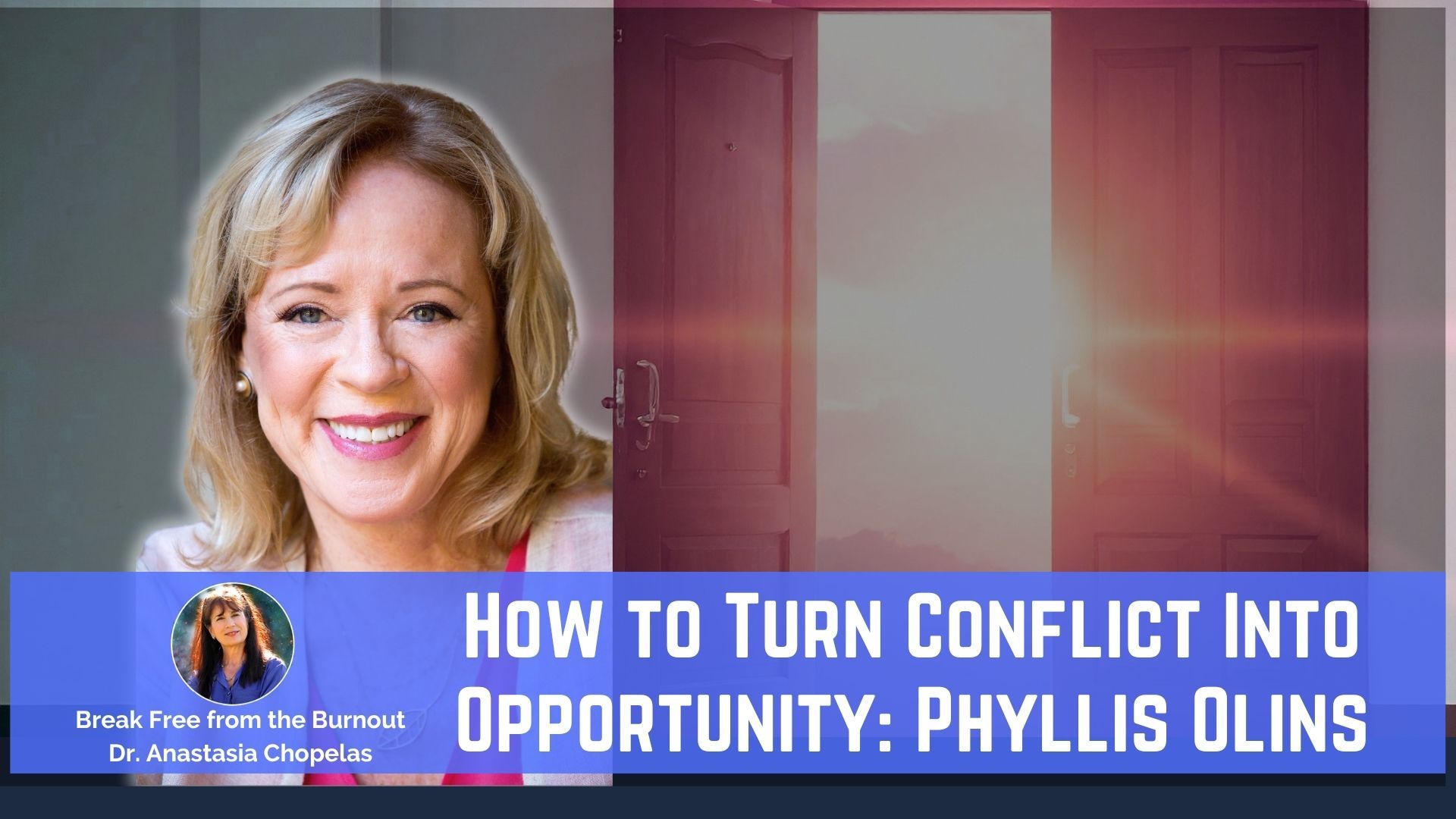
Most people try to win conflicts. What actually works is getting curious about them. In this conversation with longtime friend and conflict resolution expert Phyllis Olins — whose book The Conflict Crunch releases September 2026 — you'll see how gratitude, self-awareness, and one powerful three-word question can shift even the most entrenched relationship standoffs. No years of therapy required. No one has to be right.
There's a quote often attributed to Mike Tyson: "Everyone has a plan until they get punched in the face."
Phyllis Olins laughed when she said it. Then she added: that's exactly why she wrote a book.
Phyllis and I have known each other for 57 years. We met in 1969 at South High in Torrance — she walked onto campus as a brand-new senior without a friend in the world, and somehow we ended up losing every single tennis match we played together. What we never lost was the conversation.
She spent 30 years doing conflict resolution inside school districts. I spent the last 13-plus years bridging physics and energy healing. When we sat down recently, we kept finishing each other's sentences — because we've been circling the same truth from different directions.
Conflict, handled well, is some of the most fertile ground for growth there is. What most of us were never taught is howto handle it well.
The Woman Who Arrived Dripping Wet and Still Put On Her Lipstick
The story that launched Phyllis's entire professional path is one I keep coming back to.
She was raising her young daughter alone. Her husband had left. A woman named Mrs. Luna — mother of 16 children — came to stay at her home. Mrs. Luna had jumped into the ocean in her dress that day. When she arrived at Phyllis's front door, she was soaking wet. And before she knocked, she paused to apply her coral-colored lipstick.
Every five minutes, whatever was happening, Mrs. Luna would say: Bendito sea Dios. Praise God. Good day, hard day, it didn't matter.
What Phyllis realized — slowly, over time — was that this wasn't resignation. It wasn't spiritual bypassing. It was a choice. A deliberate, practiced decision to find something worth honoring in every moment, especially the ones that felt impossible.
That choice is the foundation of everything Phyllis teaches now.
And it runs completely counter to how most of us are wired. Your nervous system is designed to scan for threat. When someone gives you feedback and follows it with "but..." — everything before that word disappears. Your brain locks onto the criticism and camps there. This isn't weakness. It's biology. The ego runs on defense.
The question Phyllis spent 30 years exploring is: what happens when you choose, in that exact moment of lockdown, to do something different?
What the Body Already Knows About Conflict
Here's something I brought up in our conversation that I think about a lot.
The body runs on a binary system. Agonist and antagonist, always. Insulin pulls blood sugar into your cells; glucagon pulls it back out. Every regulatory system in the body has its paired opposite working alongside it. That's not a design flaw — that's how balance actually functions.
The mind works exactly the same way.
You want peace and you feel rage. You want connection and you want to protect yourself. Holding both at once isn't contradictory. It's how we're built. Phyllis's eight-step process in The Conflict Crunch works directly with this — rather than trying to suppress one side of that internal binary (which anyone who has tried to stop being angry by telling themselves to stop being angry knows doesn't work), she teaches you to find what she calls "the juice in both sides."
This is where alignment comes in — something Phyllis and I talked about at length because we've been approaching the same ideas from different angles for years.
For Phyllis, alignment is body, mind, and spirit all pointing the same direction. When that's happening, you're connected to your true self. Conflict stops feeling like a threat and starts feeling like information.
For my clients — sensitive, empathic women who often absorb everyone else's emotional weight without realizing it — this reframe is significant. The exhaustion so many of them carry isn't just physical. It's the cost of running on borrowed energy, of being pulled out of alignment by other people's unresolved patterns. Conflict, when it's chronic and unresolved, lives in the energy field long after the argument ends. That's not metaphor. That's how frequency works.
"Tell Me More": Three Words That Change the Energy of a Room
Phyllis brought up Edith Eger, and I want to stay here for a moment because the story is extraordinary.
Edith Eger survived Auschwitz. She later became a clinical psychologist. A judge asked her to work with a young neo-Nazi activist. The first words out of his mouth were that he hoped all Jews would die.
Her first reaction was human — shock, revulsion, the pull to shut down entirely.
Then she asked herself: where am I the bigot?
Not to excuse him. Not to minimize what he said. But to locate within herself that same human tendency — to blame, to reject, to protect through anger. Once she found it, she had power. And what she said to him next was: tell me more.
That question — tell me more — is one of the most energetically disarming things you can say in a conflict. It signals that you're not there to win. You're there to understand. When people feel genuinely heard, the frequency of the exchange shifts.
Einstein said we live with the optical delusion that we are separate from one another. Phyllis brought this up in the context of conflict, and it hit differently in that framing. When you're in the middle of a real fight — truly in it — the idea of being at one with the person who feels like your adversary sounds idealistic to the point of absurd.
But that's exactly the shift that creates what Phyllis calls "a magic." Not mystical magic. The magic of agency. Of realizing you have more choice in this situation than you thought.
Criticism is often projection. That's not a therapy cliché — it's something both Phyllis and I have verified through our own difficult relationships. When I'm criticizing someone and I stop to ask where I'm doing that same thing, what comes up is illuminating. Uncomfortable, yes. But clarifying in a way that nothing else quite is.
When you stop needing the other person to be wrong, you can start setting real boundaries. You can choose, with clarity, whether and how to engage. That's not skipping through roses. It's a different kind of power — one that comes from being grounded in yourself rather than reactive to someone else.
Where to Start (Before the Next Conflict Finds You)
You don't need Edith Eger's circumstances or 30 years of professional training to begin working with this. Here's what you can do right now:
- Notice the "but." When your mind locks onto the critical part of a conversation, name it out loud to yourself: I'm focusing on the negative. That awareness is the beginning of choice, not the end of it.
- Ask the projection question. When you feel critical of someone — a partner, a client, a colleague — ask where you're doing a version of the same thing. Not self-blame. Recognition of shared humanity.
- Try "tell me more." Instead of defending or shutting down, get curious. Ask the question. Watch what happens to the energy in the room.
- Clear your field before the conversation. If you're carrying unresolved emotional residue from past conflicts, you're not responding to what's actually in front of you — you're reacting through layers of accumulated energy. Clearing that first changes everything about how you show up.
That last point is where my work begins and Phyllis's intersects. She works with the mind and the meaning-making. I work with the bioelectric patterns, the frequencies that get stuck when conflict goes unresolved for years. These approaches aren't in competition — they're working on the same problem from different angles.
Conflict, when you're inside it, feels like something happening to you.
What Phyllis has spent three decades demonstrating — in classrooms, in her own life, and now in The Conflict Crunch— is that it's often something happening for you, when you know how to work with it.
That shift doesn't require perfection. It requires awareness, a bit of willingness, and the discipline to ask one more question before you react.
If the energy underneath your relationships is what's keeping you stuck long after the conversation ends, my free five-step relationship healing protocol is a good place to start. You can find it at scientifichealer.com/relationship.
A: The shift starts with how you frame the moment you're in. Rather than asking "how do I win this?" ask "what is this trying to show me?" Phyllis Olins's work focuses on finding what she calls "the juice in both sides" of a conflict — the information that lives on each side of the disagreement. When you stop trying to eliminate one side of the tension, you gain access to what the conflict is actually pointing toward. A: Gratitude isn't about pretending the situation is fine. It's about choosing — deliberately, even when it's hard — to look for what's worth honoring in the moment. Phyllis traced this back to a woman named Mrs. Luna, who praised life even in the most difficult circumstances. That practice, repeated over time, rewires your default response from defense to curiosity. That's not soft. That's a skill. A: It's a question conflict resolution expert Edith Eger asked herself when faced with an extraordinarily hostile person. The idea is to locate within yourself the same human tendency — to blame, reject, or judge — that you see in the other person. This isn't self-blame. It's a way of getting off the high ground long enough to actually connect. When you find the shared humanity in the conflict, you gain far more choice about how to respond. A: Conflict that goes unresolved doesn't just fade. It leaves patterns in your energy field — bioelectric frequencies that stay active even when the argument is technically over. For sensitive, empathic people especially, carrying unresolved relational tension is a major source of chronic depletion. Addressing both the energetic and the conversational layers of a conflict is what creates lasting relief. A: The Conflict Crunch: How to Turn Conflict Into Opportunity is Phyllis Olins's book releasing September 23rd, 2026. It's an eight-step process that uses journaling and specific tools to help you work through conflict in a way that builds rather than breaks connection. Phyllis developed it over 30 years of conflict resolution work inside school districts. You can find her at phyllisolins.com or conflictcrunch.com. Presale on Amazon: https://amzn.to/4mtVqZK .Q: How do you actually turn conflict into an opportunity instead of just surviving it?
Q: Why does gratitude matter in conflict resolution?
Q: What does "where am I the bigot?" mean in practice?
Q: How does unresolved conflict affect your energy?
Q: What is The Conflict Crunch about and when does it come out?
About