Exercise for Burnout Recovery: The 21-Minute Fix
Aug 17, 2026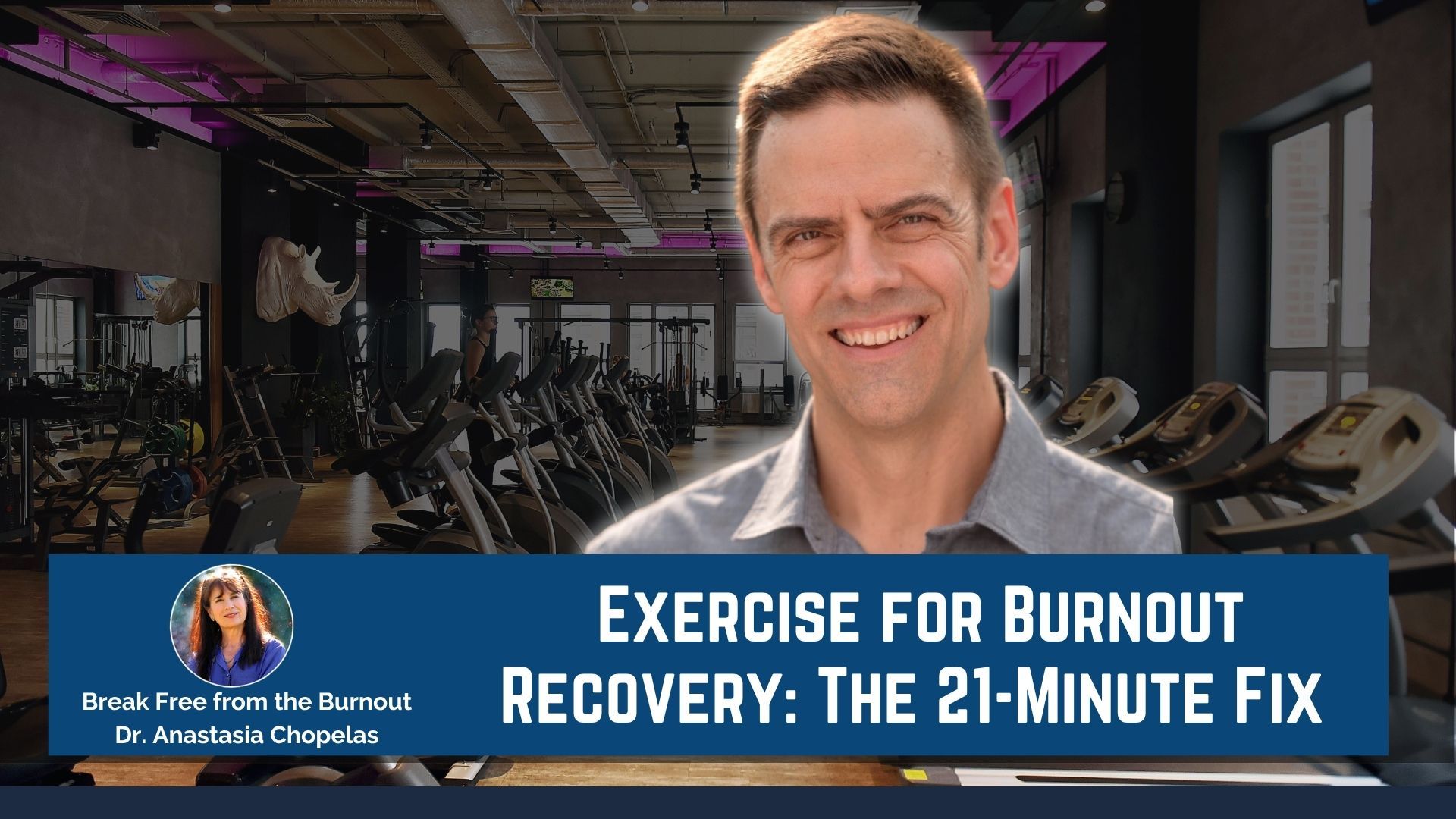
Key Takeaways
Exercise for Burnout Recovery Doesn't Require Hours You Don't Have
Twenty-one minutes of the right kind of movement can do more for a burned-out nervous system than three and a half hours of the traditional gym routine you were taught to dread. In this episode of Break Free from the Burnout, exercise scientist PJ Glassey and I break down why most workouts fail busy, sensitive entrepreneurs, why your brain type decides whether a new habit sticks or dies by February, and why the relationships you find hardest to maintain are quietly doing more for your longevity than your supplement cabinet ever will.
- The traditional "sets and reps" model was built in 1891 for bodybuilders, not for burned-out women who want to feel light, strong, and clear-headed again
- Time-under-tension training gives you strength, endurance, and a cardio effect in a fraction of the time
- "Away from" motivation (fear, sickness, shame) fizzles out — you need a "toward" vision to sustain change
- A 20-question brain type quiz can show you exactly which habits will actually stick for your wiring
- Relationships, especially the effortful ones, may be the single strongest lever for a longer, fuller healthspan
What if getting stronger, clearer, and more energized didn't ask you to hand over hours you already don't have?
That's the question I sat with for this entire conversation with PJ Glassey. PJ has spent decades — since the late 1980s, long before "biohacking" was a word anyone used — questioning the fitness industry from the inside. He's got the exercise science degree, the certifications, forty years of reading research most people never see, and a gym method that gets people real results in 21 minutes.
If you're an entrepreneur or a healer running on fumes, half-believing the only fix is one more hour you can't spare, this one's for you. We talked about why traditional training is solving the wrong problem, why your motivation keeps quietly sabotaging you, and which single habit does more for how long — and how well — you live than almost anything else on the list.
Let's start with your body, because that's where PJ started questioning everything back when he was sixteen.
Why Most Exercise Advice Isn't Built for Your Nervous System
If you're still counting sets and reps, you're following a method invented in 1891 by Eugen Sandow — a strongman who wanted to look jacked and sell his training system to men who wanted to look like him. It works beautifully if your goal is size and bulk. It was never built for someone who wants to feel strong, clear, and functional without spending three and a half hours a week getting there.
PJ's method at X-Gym throws out the traditional five-sets-of-eight-to-twelve-reps-with-two-minutes-rest model entirely. Instead, it's compound, bodyweight-based movement held under constant tension for about three minutes at a time — no rest, not even a quarter-second micro-rest, because that's all a muscle fiber needs to refuel and avoid the fatigue that actually signals your body to change. When the fibers run out of fuel and fail, that's when your body decides it needs to adapt. Because the intensity stays light enough to hold for three minutes, there's no ballistic strain and no repetitive-motion injury risk — just strength, endurance, and a heart-rate spike with every single movement, which gives you the cardio effect too. Three benefits, one 21-minute session. PJ says that's the equivalent of about three and a half hours of traditional training.
Here's the part most people miss: PJ openly admits he can't fully explain in words why this works so differently from what you already know. You have to feel it. If you've spent years associating exercise with dread, with soreness, with a workout that eats your whole evening, this reframe alone is worth sitting with — the fix for burnout-driven exhaustion may not be "push harder," it may be "train smarter, for far less time."
That reframe carries straight into the next piece, because knowing a better method exists and actually sticking with it are two very different challenges.
Why Your Motivation Keeps Failing (And What Actually Works)
Only about 5% of people who set a fitness-related New Year's resolution are still keeping it by the end of the year. PJ's explanation for that gap isn't about discipline. It's about which direction your motivation is pointing.
"Away from" motivation — I don't want to get sick like my parent did, I don't want to be out of shape — gets people started fast, but it fades the further they move away from the original fear. "Toward" motivation — seeing your future self clearly, the specific benefits waiting for you there — is what sustains the change once the initial scare wears off. As a healer, I see this constantly with clients: your subconscious mind doesn't process the word "not" the way you'd expect. Tell yourself "I don't want to be fat" and your nervous system hears "I want to be fat" and quietly moves you toward it. The people who actually keep their results are the ones who learn to convert their fear into a vision of what they're moving toward instead.
PJ built a 20-question brain type quiz around this exact problem — it sorts people into 16 different brain types, each with its own motivation preferences and about half a dozen brain-training techniques designed to rewire how that type thinks and acts. Most people test as a primary and a secondary type, which means access to roughly twelve techniques total. His advice: look for the techniques that show up on both of your types — those overlapping ones are your strongest starting point, because your brain is already wired to respond to them.
What most burnout-recovery programs skip entirely is this sequencing. They hand out a workout plan or a habit tracker without ever asking whether the motivation behind it is one that will actually hold. Fix the direction of the motivation first, and the habit stops being a fight against your own brain.
Once your motivation and your training are working with you instead of against you, there's one more piece PJ pointed to that surprised even me — sixty years into studying this myself.
The Habit That Protects Your Energy Longer Than Diet or Sleep
When PJ ranks the habits that most change how long and how well people live, exercise sits at number one, followed by nutrition, quality sleep, and brain training. But it's what rounds out his top five that stopped me: relationships.
Not surface-level, easy relationships — the close ones, the ones you can be fully honest with, the ones that sometimes take real work. PJ pointed to research out of UCLA showing that strong relationships and a sense of purpose can actually shift your epigenetics toward longevity. It's not about constant happiness. It's about the sense that you're building something with someone, which — not coincidentally — often means doing the harder emotional work rather than avoiding it.
That lines up with something I say often in this work: the people who age fastest are usually the ones chasing comfort in every direction — avoiding hard conversations, avoiding the workout, avoiding the food that actually nourishes them. The nervous system reads comfort-seeking as safety, but it's often the opposite of what keeps you resilient. The relationship that takes real effort, the exercise that's genuinely uncomfortable for those three minutes — these are the very things that protect your energy field over the long run, not the things that drain it.
This is exactly why I built the free relationship protocol I'll link below — because protecting your energy in your closest relationships is inseparable from protecting your energy everywhere else.
What To Do Next
You don't need a complete overhaul this week. Start here:
- Pick one compound, bodyweight or light-resistance movement and hold continuous tension for three minutes with zero rest — feel the difference for yourself before judging it from the outside
- Write down your current "away from" fear about your health or your business, then rewrite it as a specific "toward" vision of the person you're becoming
- Take PJ's free 20-question brain type quiz at Xgym.com and look for the training techniques that overlap between your primary and secondary type
- Choose one relationship you've been avoiding the harder conversation in, and give it a little more of your energy this week, not less
- Watch the full conversation below — PJ shares even more of the research and the reasoning I couldn't fit into this recap
You came into this already carrying more than enough. What today's conversation with PJ makes clear is that recovering your energy for burnout doesn't ask for more hours, more willpower, or more sacrifice — it asks for the right 21 minutes, the right motivation, and the right relationships. Watch the full episode below, and if it resonates, share it with another entrepreneur who needs to hear it too.
Until next time, sending you golden healing light and success vibes as you become more energized, aligned, and prosperous. Your gifts are so needed in this world.
Frequently Asked Questions
Q: What is time under tension training, and how is it different from traditional sets and reps? A: Time under tension training holds a muscle in continuous, uninterrupted tension for about three minutes, rather than doing short 10-second sets with long rest periods in between. Because there's no rest — not even a quarter-second micro-rest — the muscle fibers run out of fuel and fail, which is what actually signals the body to adapt. This single approach builds strength, endurance, and a cardio effect at the same time.
Q: Why do most fitness New Year's resolutions fail? A: Roughly 95% of people who set a fitness resolution abandon it by year's end, largely because their motivation is pointed in the wrong direction. "Away from" motivation, like fear of illness, fades as the fear becomes less immediate. Lasting change usually requires "toward" motivation — a clear, specific vision of the person you're becoming.
Q: What is a brain type test, and how does it help with habit change? A: A brain type test is a short quiz (PJ Glassey's version is 20 questions) that sorts people into one of 16 brain types, each with its own motivation style and a set of matching brain-training techniques. Most people test into a primary and secondary type, and the techniques that overlap between the two tend to be the easiest starting point for real change.
Q: How much exercise do I actually need for burnout recovery? A: According to PJ Glassey, roughly 21 minutes of properly designed, intense, compound-movement training can be equivalent to about three and a half hours of traditional training in terms of strength, endurance, and cardio benefit. Intensity and continuous tension matter more than total time spent.
Q: Why do relationships matter for longevity and energy, not just diet and exercise? A: Research referenced from UCLA suggests that strong relationships and a sense of purpose can influence epigenetics in ways that support longevity. Close, effortful relationships — the kind that require real emotional work — appear to support both nervous system resilience and long-term health more than comfort-seeking does.
Ready to protect the energy you're pouring into every relationship in your life?
Grab my free 5-Step Relationship Healing Protocol at scientifichealer.com/relationship — a simple starting point for releasing what's draining you and building the connections that actually restore you.
Full show notes and resources for this episode are available at breakfreefromtheburnout.com.
About